Zone Zero
– An expert assessment of Zone Zero by Todd Lando, Fire Battalion Chief and Board President of Fire Safe Marin. (See bio & additional details below)
Wildfire season is no longer just a “season” in California. It’s year-round and high risk. And yet, amid smoke and ash, the debate over a five-foot buffer regulation around homes, dubbed “Zone Zero,” has reached a critical juncture.
Recent UC Berkeley and University of Maryland research confirms that clearing combustible materials within five feet of homes provides the single greatest reduction in structure loss during WUI fires.
What began as a straightforward, science-backed policy proposal is now weighed down by misinformation, anecdotes, and contradictory logic. However, at its core, the question remains simple: should combustible materials, including vegetation, be allowed within five feet of a home, the very area where most structures ignite during wildfires?
The Facts and the Science
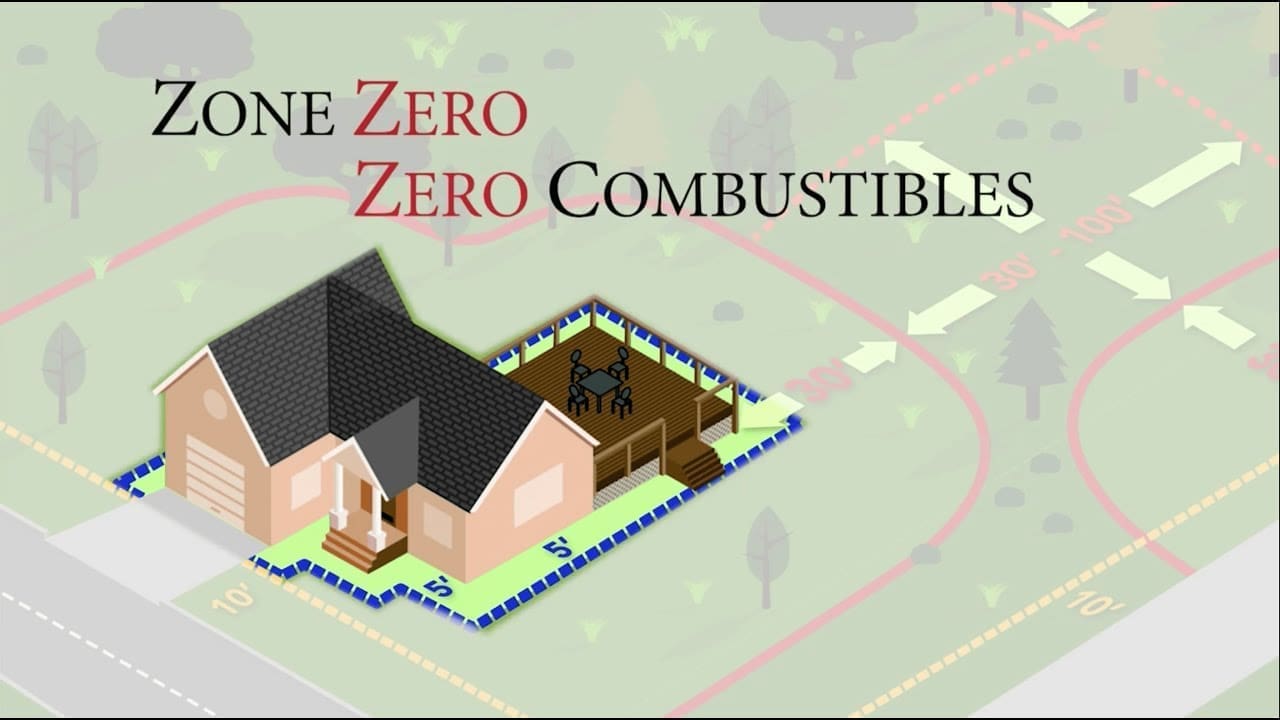
Zone Zero is not about landscaping preferences or aesthetics. It is about survival. This narrow strip of space is where the fate of a home is often sealed:
- Embers accumulate in this zone
- The radiant heat is most intense in this space
- It is the only defensible space touching the structure
- It is where almost every home first ignites
Even the most hardened house, one with ember-resistant vents, tempered glass, and non-combustible siding, is vulnerable if mulch, shrubs, hedges, firewood, or wooden fences create ignition pathways in this critical zone.
The Irrigated Vegetation Mirage
Critics argue that “hydrated” or “well-maintained” vegetation should be allowed in Zone Zero, citing incidents of homes that survived with green plants nearby. But this is correlation at best, and is not causation. Fire science is unequivocal: all plants are combustible.
Requiring additional irrigation introduces multiple failure points. Water pressure drops, system failures occur, and additional maintenance requirements compound the likelihood of disaster. Even lush plants can dry rapidly during red flag weather, turning into fuel. Inspectors cannot measure moisture levels reliably, nor know if irrigation will fail later. Only objective, proven measures ensure safety.
Encouraging irrigated vegetation also contradicts decades of water conservation efforts. California water agencies have long urged xeriscaping, drought-tolerant natives, and gravel instead of thirsty ornamentals. To demand lush greenery from the walls to the property boundary is dangerous, inconsistent, and unsustainable.
Misconceptions About Trees and Neighborhoods
Some argue Zone Zero will strip tree canopy. In reality, it hardly affects trees. Mature trees rarely grow within five feet of homes, and the rule exempts those that do, provided they are well maintained. The true hazard is not tree canopies but the leaf litter and low branches that accumulate against walls, in gutters, and on rooftops.
Others point to “structure separation distance,” noting that tightly packed homes are more likely to burn. While they are at heightened risk, this is not an excuse for inaction. We cannot move homes farther apart, but we can remove fuels that embers use to ignite the homes. A clean Zone Zero slows house-to-house fire spread, often making the difference between isolated loss and widespread destruction.
Eliminating Failure Points
Wildfire safety is not about adding complexity; it’s about eliminating failure points. Systems that rely on power or last-minute action can fail. Exterior sprinklers stop when electricity goes out. Fire gels wash away. Irrigation dries up. The simplest, safest approach is to eliminate the fuel.
- Gravel, pavers, or hardscape instead of bark mulch.
- Non-combustible siding and decking instead of wood.
- Radiant-heat-reflective fencing instead of hedges.
Combined with home hardening elements, these choices create systems that withstand wildfire without relying on luck or intervention. When there’s nothing to burn, there’s nothing to ignite.
Control What We Can
We cannot control wind, terrain, or the density of our neighborhoods. But we can control what’s within five feet of our homes.
Although Zone Zero would adjust requirements for only a small portion (less than 2%) of the defensible space already governed by California law, it dramatically increases the effectiveness of those regulations. Its success depends on clear standards, consistent enforcement, and an uncompromising commitment to safety.
Zone Zero is not about creating barren yards. It is about shifting plants beyond the five-foot zone, where they can still provide shade and beauty without creating ignition pathways. By focusing on non-combustible design and aligning safety with California’s water reality, we build landscapes that are vibrant, sustainable, and resilient.
Zone Zero is essential. It is the line where the fight to save homes is won or lost.
About the author
Todd Lando, President of Fire Safe Marin; Battalion Chief/Wildfire Hazard Mitigation Specialist of Central Marin Fire Authority

With more than 34 years in the fire service, Todd Lando worked on the front lines of wildfire and in the trenches of planning, education, and fire science. His focus is on helping communities adapt to wildfire through defensible space, home hardening, fuel mitigation, and honest, evidence-based communication. Lando coined the term “Zone Zero” in 2018 to describe the well documented science and field experience around the five feet that matter most — and he is still working to make sure people understand why that zone can make the difference between survival and loss.
Read the original two articles on LinkedIn: