IN THE EVENT OF AN EMERGENCY THIS SITE IS NOT MONITORED. FOR CURRENT INFORMATION GO TO HTTPS://EMERGENCY.MARINCOUNTY.GOV.
Zone 0: Protect the First Five Feet Around Your Home
UPDATE – SEPTEMBER 14, 2026:
The Zone 0 regulations are under further review by the Board of Forestry and Fire Protection. For additional information, please visit the Board of Forestry and Fire Protection’s website.
California’s Zone 0 regulations
The California Board of Forestry and Fire Protection Zone 0 regulations apply in State Responsibility Areas, which includes most of unincorporated Marin, and to properties in cities, towns, and other Local Responsibility Areas that the state has mapped as Very High Fire Hazard Severity Zones. Most homes inside Marin’s cities and towns are not in that category yet; Marin’s fire agencies are working on a consistent countywide approach, and each city council and fire district board will make its own decision. New construction must comply as soon as the rules take effect. Existing homes have three to five years to complete most of the work.
Fire Safe Marin’s recommendation has not changed:
The state regulation is a legal floor. What is permitted is not what is recommended. Keep the entire first five feet around your home free of anything that can burn. Research on more than 47,000 homes in five major California wildfires found that clearing the first five feet, combined with home hardening, roughly doubled a home’s predicted chance of surviving a wildfire (Zamanialaei et al., Nature Communications, 2025 *). A separate analysis of insurance claims found that heavy vegetation within five feet nearly doubled the chance a home was destroyed by the fire (Zesty.ai, 2021, cited in the IBHS Zone 0 white paper for the Board of Forestry **).
What is Zone 0?
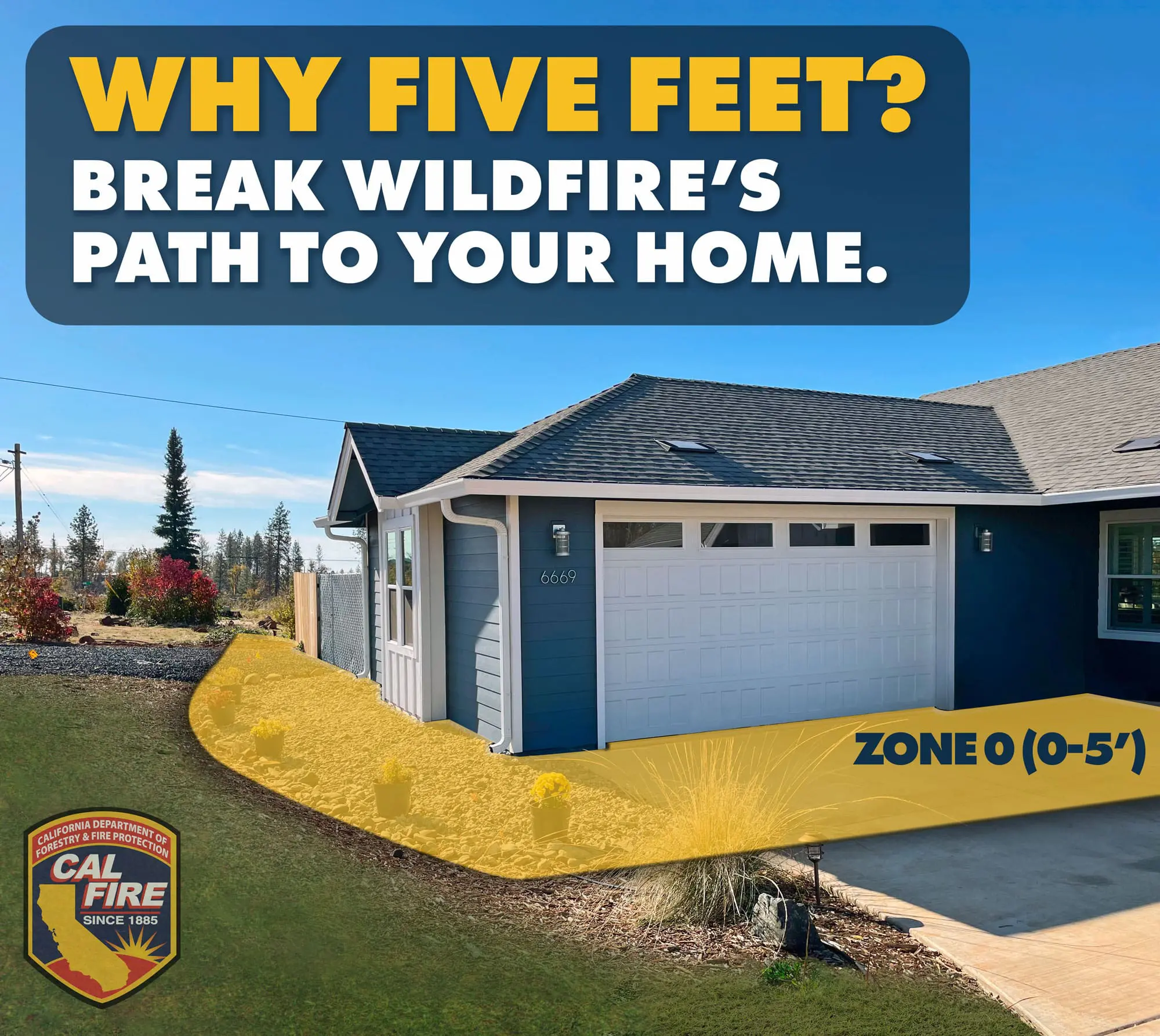
The first five feet around your home, known as Zone 0, can make a major difference during a wildfire. Zone 0 includes everything from 0 to 5 feet out from a building’s exterior walls, roof edge, and attached decks, stairs, or pergolas. Self-supporting features located within one foot of the main structure would generally be treated as “attached structures.”
Agencies such as CAL FIRE sometimes refer to Zone 0 as the “ember-resistant zone” because wind-blown embers often collect against exterior walls, beneath eaves and decks, in gutters, and among landscaping or stored materials. If something in this area ignites, flames can quickly spread directly to the home. Reducing fuel in this area helps interrupt the path embers and flames may take to your home.
Removing combustible materials from Zone 0 helps break the fire path and gives your home a better chance of surviving a wildfire.
What do the state regulations require?
The regulations divide Zone 0 into two areas:
- A noncombustible “safety zone” next to the home and its most vulnerable features
- A low-combustibility zone extending from the “safety zone” to the outer edge of the five feet
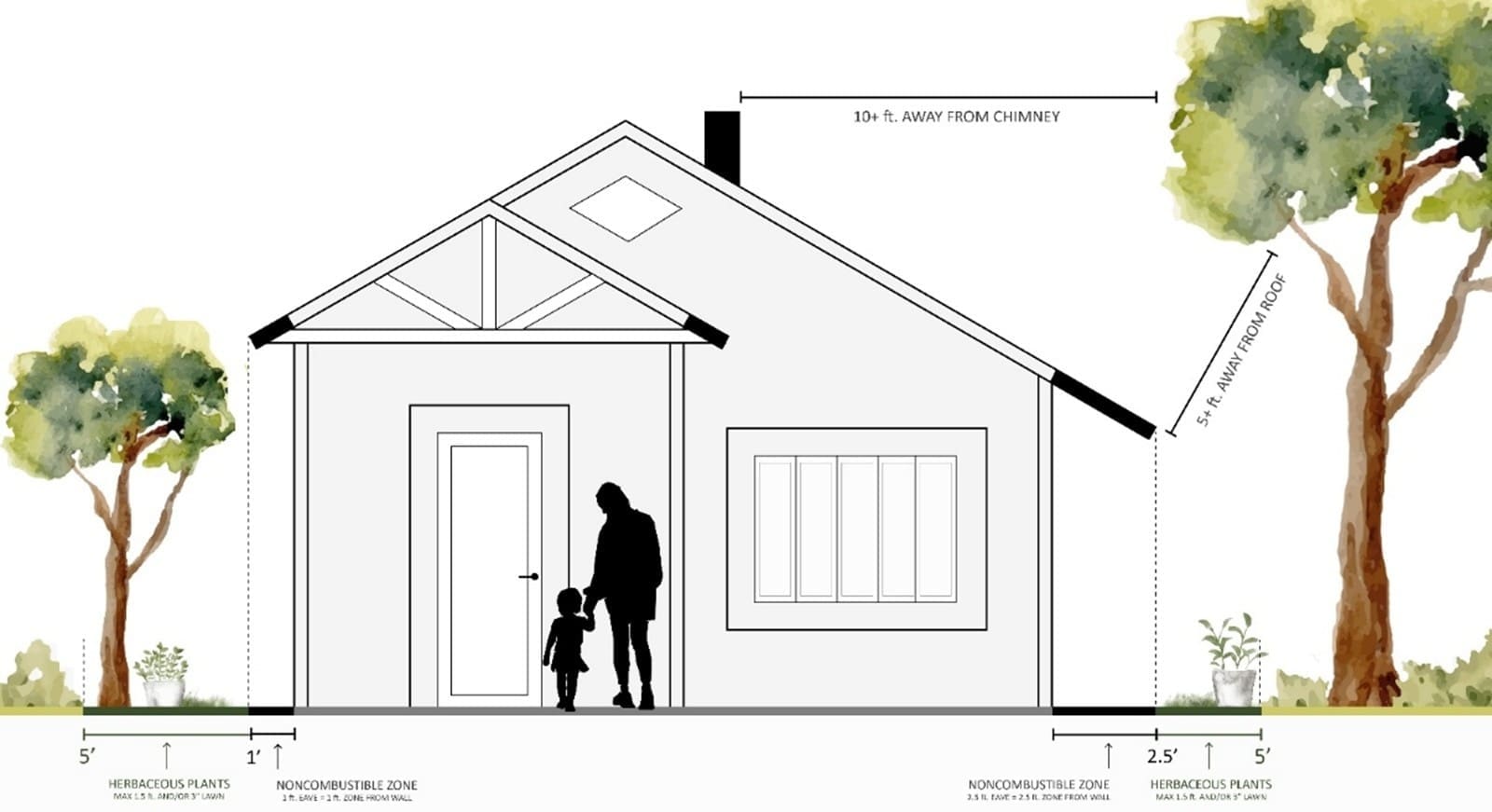
The safety zone must extend:
- At least one foot from an exterior wall
- At least two feet from windows, doors, and vents
- Five feet from attached decks, stairs, and pergolas
- To the edge of an eave if the eave extends farther than one foot from the wall
For example, a home with a three-foot roof overhang would generally need a three-foot vegetation-free area “safety zone” beneath the eave. However, the safety zone does not extend beyond the five-foot boundary of Zone 0.
Throughout Zone 0, the regulations prohibit combustible materials such as:
- Fallen leaves, needles, twigs, and other debris
- Bark, wood chips, and other combustible mulch
- Firewood and stored lumber
- Dead or dying vegetation
- Combustible items stored beneath decks, balconies, pergolas, or stairs
- Other materials that could ignite and spread flames
Additionally, roofs and rain gutters must also be kept clear of combustible debris.
What does Fire Safe Marin recommend?
Keep the entire first five feet around your home free of anything that can burn. This has been Fire Safe Marin’s recommendation since Marin’s fire agencies developed local Zone 0 standards in 2018.
Fire Safe Marin recommends that your Zone 0 has:
- No wood or bark mulch
- No woody plants
- No firewood or stored lumber
- No combustible furniture or stored items
- No combustible fence or gate connected directly to the home
- No buildup of leaves, needles, branches, or other debris
It is recommended that you use gravel, rock, pavers, concrete, bare soil, or other noncombustible materials instead.
The state regulations allow a limited amount of low, non-woody vegetation in part of Zone 0. However, what is permitted under the state regulations is not necessarily what provides the greatest protection. Fire Safe Marin continues to recommend a fully noncombustible five feet around every home.
Questions & Answers
Does the state Zone 0 rule apply to my home?
The state regulations apply to properties in:
- State Responsibility Areas
- Very High Fire Hazard Severity Zones within Local Responsibility Areas
If your property is in the State Responsibility Area, which covers most of unincorporated Marin, the regulations apply. If you live in a city or town, or in an unincorporated neighborhood that is Local Responsibility Area, they apply only if your property is mapped Very High. If you live within an incorporated city or town, they apply only if your property is mapped in a Very High Fire Hazard Severity Zone. They do not apply in Federal Responsibility Areas.
Fire Hazard Severity Zones are areas the state has classified as having moderate, high, or very high wildfire hazard. These zones are different from the Wildland-Urban Interface, or WUI, which identifies areas where homes and neighborhoods meet or intermingle with open space and wildland vegetation.
Check the state’s Fire Hazard Severity Zone maps or contact your local fire agency to confirm whether the state rule applies to your property.
Regardless of where you live, Fire Safe Marin recommends keeping the entire first five feet around your home free of anything that can burn.
When do the requirements take effect?
With the regulations, new construction will need to meet the Zone 0 requirements immediately. Existing properties will have a phased compliance period.
When the regulations take effect
- Remove combustible debris from roofs and rain gutters.
- Remove firewood from Zone 0.
- Remove dead tree branches.
- Keep branches at least 10 feet from chimneys and clear of eaves.
If these sound familiar, they should. State defensible space law and Marin’s local fire codes have required them for years.
Within three years
- Remove combustible mulch, wood chips, leaves, branches, and similar materials from Zone 0.
- Remove dead and dying plants.
- Complete required tree maintenance.
- Remove or adjust vegetation to meet the state requirements.
- Maintain permitted vegetation according to the required height, spacing, and maintenance standards.
Within five years
- Local jurisdictions will establish a timeline for:
- Creating the required vegetation-free safety zone next to the home and beneath eaves
- Replacing combustible gates where required
- Making required changes to fences
- Making required changes to sheds and outbuildings
The phased timeline is intended to give homeowners time, guidance, and access to assistance while they make progress.
Could Marin’s local requirements be different?
The state regulations establish a minimum legal standard. Local jurisdictions may adopt more protective requirements.
Within Local Responsibility Areas, fire agencies may also authorize alternative practices based on local conditions such as topography, lot size, building density, vegetation types, fire risk, emergency-response resources, and fire-resistant construction. Any alternative must provide substantially similar fire-safety benefits and receive approval from the appropriate governing body.
Marin’s fire agencies are working toward a consistent countywide approach. Decisions will ultimately rest with the appropriate city councils, fire district boards, and other governing bodies. Fire Safe Marin will update this page as local decisions are made.
Are plants allowed in Zone 0?
The state regulations permit some well-maintained, non-woody vegetation within Zone 0 but it is required to be outside of the safety zone. This may include:
- Lawns and low ground covers maintained below three inches
- Small, non-woody plants and flowers that meet the spacing requirements
- Certain bulbs, annual flowers, herbaceous plants, and non-thatching succulents
- Plants no taller than 18 inches in movable, noncombustible containers
All permitted plants must be kept free of dead or dying material and away from walls, eaves, windows, doors, vents, decks, stairs, and pergolas.
Although limited vegetation may be legally permitted, Fire Safe Marin recommends keeping the entire five feet noncombustible whenever possible.
Can trees remain in Zone 0?
Existing trees may remain when properly maintained and separated from vulnerable parts of the home. Under the regulations:
- Dead and dying branches must be removed.
- Lower branches and ladder fuels must be removed from the bottom six feet of a large tree or the lower one-third of a smaller tree, whichever is less.
- Branches must remain at least 10 feet from chimneys and stovepipe outlets.
- Branches must be kept clear of eaves and at least five feet above roofs.
- A defensible-space inspector may evaluate whether an individual tree could transmit fire to the structure.
- New trees may not be planted within Zone 0 once the regulations take effect.
What do I need to do with fences, gates, sheds, etc.?
The regulations require a noncombustible five-foot section of fence or gate where it attaches to the home or comes within a foot of the building. New combustible fences and gates will not be allowed within Zone 0, although repairs to existing combustible fences may continue to use combustible replacement materials.
A metal gate or noncombustible fence section can help stop a burning fence from carrying flames directly to the home.
Sheds and qualifying outbuildings within Zone 0 must have noncombustible exterior walls and roofs.
Do I need to remove my garden or replace my fence now?
No. The regulations do not require the immediate removal of gardens, fences, or other existing features.
Most vegetation changes for existing properties will be phased in over three years. Changes involving safety zones, fences, gates, sheds, and outbuildings may be phased in over as many as five years.
However, if you are already replacing landscaping, a fence, or a gate, consider following Fire Safe Marin’s full five-foot standard now. Doing the work correctly today can help you avoid having to redo it later.
If a fire agency inspection has already identified work needed at your home, those requirements still apply.
What about insurance or financial assistance?
Insurance requirements vary and may be more protective than the state minimum. Some insurance companies and wildfire-mitigation programs expect a fully noncombustible five feet around a home.
Meeting the state’s minimum requirements may not satisfy your insurance company. Contact your insurer directly to understand its requirements before making landscaping or home-improvement decisions.
Marin Wildfire grant programs may help eligible residents complete wildfire-risk reduction work, including certain Zone 0 improvements.
Your Wildfire Risk Report can help you identify and prioritize recommended work. Visit Marin Wildfire’s Wildfire Risk Home Evaluation Program to access your report and learn more about available assistance.
What you can do now
You do not need to wait for a deadline to begin reducing your wildfire risk:
- On a regular basis, clear leaves, needles, and debris from the ground, roof, gutters, and beneath decks.
- Move firewood, lumber, and combustible storage away from the home.
- Replace bark or wood-chip mulch with gravel, rock, pavers, or another noncombustible material.
- Remove dead branches and ladder fuels from trees.
- Keep plants away from walls, windows, vents, doors, decks, and areas beneath eaves.
- Use a noncombustible fence or gate connection where fencing meets the home.
First five feet, nothing that burns. Start now.

Learn more
- Fire Safe Marin’s defensible-space guidance
- CAL FIRE defensible-space information
- CAL FIRE Fire Hazard Severity Zone maps
- Approved final draft of Zone 0 defensible space regulations
- California Board of Forestry and Fire Protection Zone 0 information
- Board of Forestry’s explainer video: The process and what regulations require
- Board of Forestry’s news release, 8/19/2026